Plan a Zero-Downtime Deployment Workflow
Design a repeatable deployment with immutable artifacts, readiness checks, backward-compatible migrations and tested rollback.
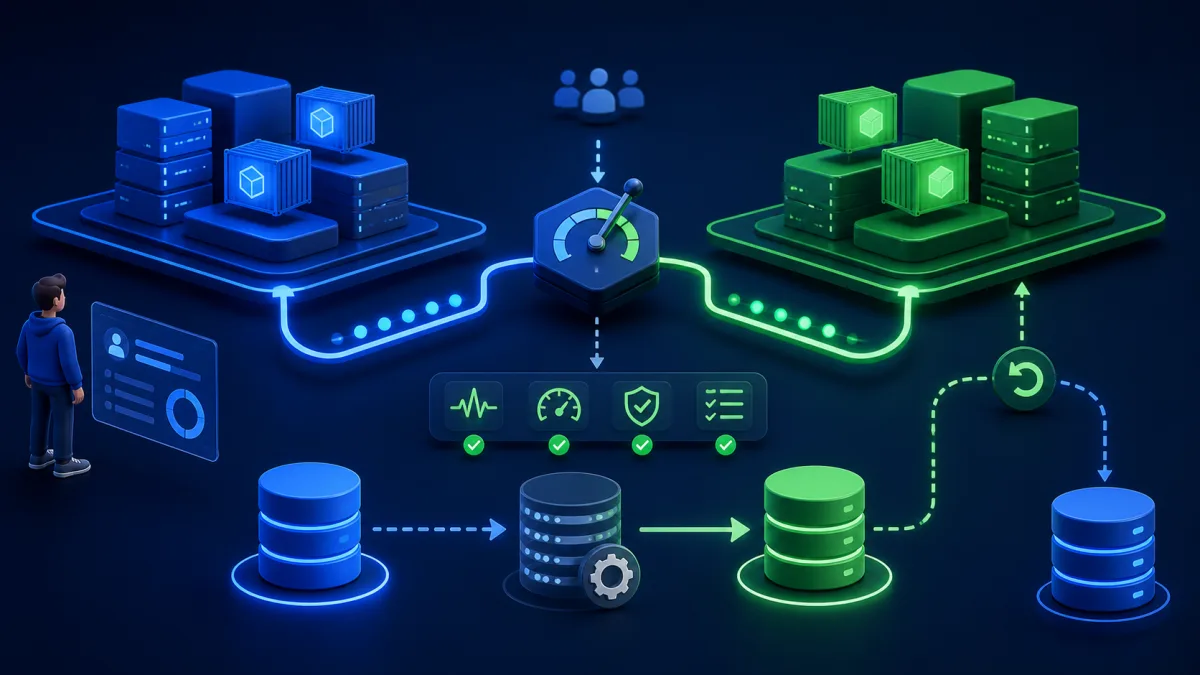
Design a repeatable deployment with immutable artifacts, readiness checks, backward-compatible migrations and tested rollback. This guide treats the change as an operational procedure that must be verified, monitored and reversible.
Scope and assumptions#
Use a production-style test environment. Replace all placeholders and rehearse state-changing commands before production.
Prerequisites#
- A staging environment and deployable application
- A current backup or documented rollback point
- Access to logs, health checks and monitoring
Define the safe outcome#
Record expected behavior, acceptable interruption and rollback signals. Capture a baseline so the result is measured rather than guessed.
Implement the change#
build once -> scan -> deploy canary -> readiness check
-> expand database migration -> shift traffic
-> monitor error rate and latency -> complete or roll back
-> contract old schema in a later release
Keep credentials outside source control and use the smallest permissions required.
Verify before real traffic#
Run the workflow with synthetic traffic; intentionally fail readiness and prove traffic remains on the healthy version.Check the user-visible path and its dependencies. A running process is not proof of a healthy system.
Failure modes to test#
- The new process never becomes ready.
- A dependency is slow or unavailable.
- Two operations run concurrently.
- Rollback is required after traffic or data moves.
- Logs leak sensitive data or lack request context.
Rollback plan#
Preserve the previous artifact or configuration. Keep schema changes backward compatible and document the exact restoration command or traffic switch.
Monitoring and alerting#
Monitor latency, errors, saturation and the domain outcome affected by the change. Every alert should point to an actionable runbook.
Security considerations#
- Use encrypted transport and least-privilege identities.
- Never log passwords, tokens or complete private payloads.
- Allow-list client-controlled options.
- Patch runtimes and dependencies on a documented schedule.
Common problems#
It works manually but not as a service#
Compare user, working directory, environment, network access and filesystem permissions.
The change cannot be reversed#
Split incompatible work into expand, migrate and contract phases.
Health checks pass while users see errors#
Add readiness checks for critical dependencies and synthetic checks for the complete external path.
Production checklist#
- Configuration reviewed and versioned
- Secrets supplied through the approved store
- Rollback artifact verified
- Health checks passing
- Dashboards open during rollout
- Rollback owner identified
Conclusion#
The work is complete only when behavior is measured, failure paths are understood and rollback remains available. Record the final state in the runbook.