Run Docker Compose Safely in Production
Adapt Docker Compose for production with pinned images, secrets, health checks, resource limits and controlled updates.
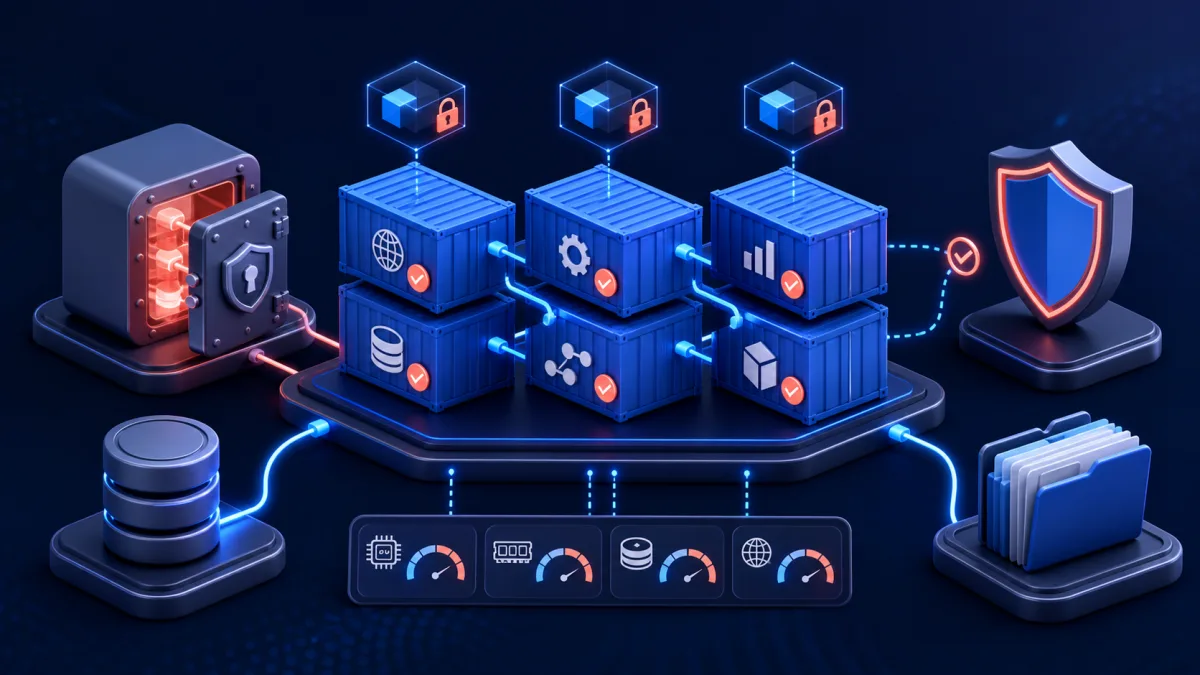
Adapt Docker Compose for production with pinned images, secrets, health checks, resource limits and controlled updates. This guide treats the change as an operational procedure that must be verified, monitored and reversible.
Scope and assumptions#
Use a production-style test environment. Replace all placeholders and rehearse state-changing commands before production.
Prerequisites#
- Docker Engine and Compose
- A current backup or documented rollback point
- Access to logs, health checks and monitoring
Define the safe outcome#
Record expected behavior, acceptable interruption and rollback signals. Capture a baseline so the result is measured rather than guessed.
Implement the change#
services:
  app:
    image: registry.example.com/app:YOUR_IMAGE_TAG
    restart: unless-stopped
    read_only: true
    tmpfs:
      - /tmp
    healthcheck:
      test: ["CMD", "wget", "-qO-", "http://localhost:3000/health"]
      interval: 30s
      timeout: 5s
      retries: 3
Keep credentials outside source control and use the smallest permissions required.
Verify before real traffic#
docker compose -f compose.yaml -f compose.production.yaml config
docker compose up -d --wait
docker compose ps
Check the user-visible path and its dependencies. A running process is not proof of a healthy system.
Failure modes to test#
- The new process never becomes ready.
- A dependency is slow or unavailable.
- Two operations run concurrently.
- Rollback is required after traffic or data moves.
- Logs leak sensitive data or lack request context.
Rollback plan#
Preserve the previous artifact or configuration. Keep schema changes backward compatible and document the exact restoration command or traffic switch.
Monitoring and alerting#
Monitor latency, errors, saturation and the domain outcome affected by the change. Every alert should point to an actionable runbook.
Security considerations#
- Use encrypted transport and least-privilege identities.
- Never log passwords, tokens or complete private payloads.
- Allow-list client-controlled options.
- Patch runtimes and dependencies on a documented schedule.
Common problems#
It works manually but not as a service#
Compare user, working directory, environment, network access and filesystem permissions.
The change cannot be reversed#
Split incompatible work into expand, migrate and contract phases.
Health checks pass while users see errors#
Add readiness checks for critical dependencies and synthetic checks for the complete external path.
Production checklist#
- Configuration reviewed and versioned
- Secrets supplied through the approved store
- Rollback artifact verified
- Health checks passing
- Dashboards open during rollout
- Rollback owner identified
Conclusion#
The work is complete only when behavior is measured, failure paths are understood and rollback remains available. Record the final state in the runbook.